Showing posts with label chicken. Show all posts

Tuesday, April 14, 2015

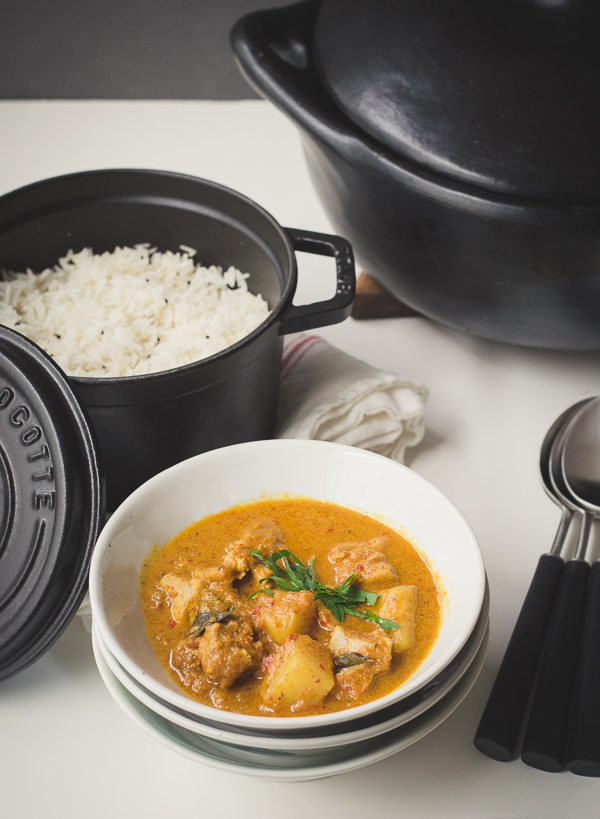
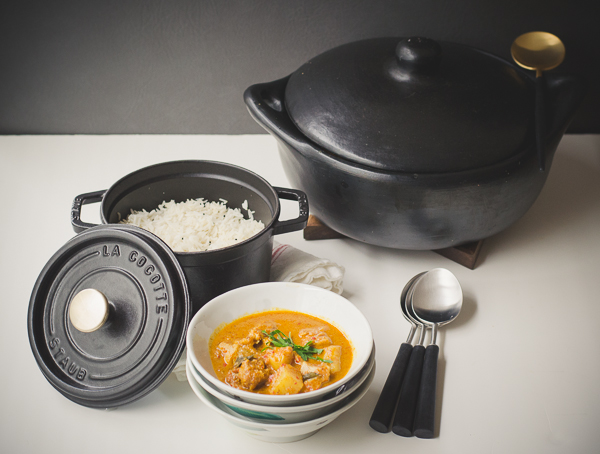
Low FODMAP Chicken Curry


This recipe contains no garlic or onions but utilizes carrots, radish and fennel to approximate the consistency of real curry. Curry is after all, so much more than just a pungent and spicy stew - it's the perfect marriage of color, spice and texture. Gruel-like curries are nauseatingly inauthentic, so please use a good quality, creamy coconut milk to achieve the beautiful sandiness of crimson hued curdled fat globules. I use Aroy-D's 100% coconut milk that comes in a Tetra-Pak - use what is necessary and freeze the leftovers.

My great-grandmother was a noodle hawker who made the best chicken curry laksa in the world (in my own very small world, she was a legendary cook) and my mother's own interpretation of this classic Malaysian dish is a phenomenal second.  I therefore, am blessed with the advice of two marvelous cooks on making the perfect Malaysian chicken curry - always use candlenuts, lemongrass and curry leaves, and always use the best chilies you can find. I like using Korean chilies because they resemble Southeast Asian chilies the most, the South American/Mexican kind tend to have thicker skins that do not blend well. In a pinch, you can use gochugaru (Korean dried chili flakes) - about 1/4 cup of gochugaru soaked in 2 tablespoons water will yield about 25 dried chilies.

My mother uses Babas curry powder which she swears differs completely from your regular Indian curry powder (she lugs a whole boxful of Babas in several varieties every time she visits), but in case you have no one to bring you that perfect curry powder from half-way across the world, my experience tells me that a good Madras-style curry powder that contains no garlic or onion powder works equally well.

I realize after my spiel about authenticity that a food processor and boneless/skinless thighs may not help my case, but it does make things somewhat easier to chuck everything in a processor than grinding away on a mortar and pestle (and honestly, it really doesn't make an ounce of discernible difference). Please use bone-in chicken cut into small pieces if you can, it really does make for a much tastier dish - I only use boneless/skinless thighs because they defrost and cook really fast. I've adapted the recipe for a quick dinner, though it still takes about 90 minutes total from start to finish.


Low FODMAP Malaysian Chicken Curry
Makes about 6 servings

Curry base
2 medium carrots (about 5 oz. total)
1 small daikon radish (about 3 oz.)
1 small fennel, fronds removed
1 thumb-sized ginger, peeled
3 candlenuts (or sub. macadamia nuts)
25 dried Korean chilies, soaked in hot water for twenty minutes then discard the water

2 tablespoons ghee (if going dairy free, sub with equal amount avocado oil)
2 tablespoons coconut oil
1 tablespoon hot curry powder
1 teaspoon asafetida
2 stalk lemon grass, cut into thirds
10 curry leaves
20 oz. coconut milk

1.5 lbs boneless, skinless chicken thighs, cubed
4 medium Yukon gold potatoes (about 1.25 lbs), cubed
2 teaspoons coconut sugar (or regular brown sugar)
Salt to taste (about 2 - 3 teaspoons)

Blitz all the curry base ingredients in a processor until very fine.

Heat the ghee and coconut oil over medium heat and add the curry base, curry powder and asafetida. Fry until the mixture is fragrant and slightly golden, about 20 minutes. Add coconut milk, lemongrass and curry leaves - bring to a gentle simmer for a few minutes.

Add chicken and potatoes. Simmer, covered for about 25 - 30 minutes until potatoes are soft but not mushy. Stir in the sugar and season with salt to taste. Serve with basmati rice cooked in ghee and black mustard seeds.

---------------------------------------------


Bowls: vintage; Cocotte: Staub; Clay Pot: La Chamba; Spoons: Cutipol 

Wednesday, October 16, 2013

Moroccan-inspired Chicken Tagine

La Chamba clay pot, Le Souk Ceramique pasta bowl, Akiko's Pottery serving bowl, Sabre Natura flatware

I'll confess that I've never been to Morocco, but I have been trying to perfect the art of a good chicken tagine for about 7 years. I don't own a tagine because I don't make enough Moroccan stews in a year to warrant one. I already have an insane assortment of cookware that is never used because I store it in the basement and I'm always too lazy to fight through an array of boxes to get to them.

Since a chicken tagine is basically just chicken stew cooked in a conical-shaped clay pot (the tagine), it's easy to reproduce the benefits of cooking in a tagine if you understand the science. The conical shape of the tagine helps to keep the meat moist by allowing the escaping air to condense and fall back into the stew, hence conserving water. You can pretty much achieve the same thing by using a pot with a tightly fitting lid over very low heat. The second thing that is specific to a tagine is that it's made of clay. Food cooked in a clay pot tends to be much more moist and much less oil is needed because the juices from the food actually clog the pores of the clay pot and you end up with the food stewing, basically in its own juices.

Clay pots also have "memory" of the place they were mined from, based on mineral content of the soil - sort of like the description of "terroir" when it comes to wine. Food cooked in a pot from Japan will taste slightly different from that cooked in a pot from Espirito Santo in Brazil. I make my chicken tagine in a La Chamba casserole and I think it approximates the tagines I've tasted in Moroccan restaurants, but if you want something really authentic, you will have to invest in a genuine tagine made in Fez. In a pinch, you can use a dutch oven or even a regular porcelain casserole - any sort of pot with a tight lid will work.

This recipe was adapted from writings by Paula Wolfert, Ghillie Basan and lots of internet research. I call this Moroccan-inspired because I can't truly say that this is exactly like the tagines they eat in Morocco... one day perhaps.

Moroccan-inspired Chicken Tagine
Cooking time: 2 hours plus marinading overnight
Yields about 4 servings

1 whole chicken (about 4lbs), cut into 8 pieces (or 4 thighs and 4 drumsticks), skin removed

Rub
2 tablespoons ghee (use melted butter if ghee is unavailable)
2 teaspoon Ras-el-Hanout
1 teaspoon ground ginger
1 teaspoon turmeric
1 teaspoon ground cumin
1/2 teaspoon paprika for color

2 large sweet yellow onions, sliced into 1/4 inch rings
3 medium carrots, rough chop
1/2 cup pitted green olives
1/2 teaspoon saffron threads, crumbled and soaked in 1/4 cup water
One handful of cilantro
One handful of parsley
1 teaspoon pepper
1/2 teaspoon salt
1/4 cup dried Turkish apricots, rough chop

  1. Wash and pat chicken dry. In a large baking pan or roaster, massage the chicken pieces with the ingredients from the rub. Cover with cling film and refrigerate overnight.
  2. The next day, heat olive oil in pan and brown the chicken pieces on both sides, becareful not to overcrowd the pan while browning. 
  3. On the stovetop, heat your clay pot over medium-low heat with a drizzle of olive oil. Lay the sliced onions at the bottom of the pot and add the carrots on top of it. 
  4. Place the browned chicken on top of the carrots, skin side down in a single layer if possible. 
  5. Scatter the olives and saffron-infused water  (along with the saffron threads) around the edges of the pot. 
  6. Lay the cilantro and parsley on top of the chicken and cover. If there is a gap between the lid and the pot, you can use a damp and rolled kitchen towel to form a buffer.   
  7. In the meantime, heat the oven to 300F. When the oven is heated, pop your casserole in and cook for about an hour. 
  8. After an hour, flip the chicken over, add salt, pepper and apricots and cook for another hour. 
  9. Remove from oven, let cool and serve with either flatbread or potatoes and lots of harissa.